
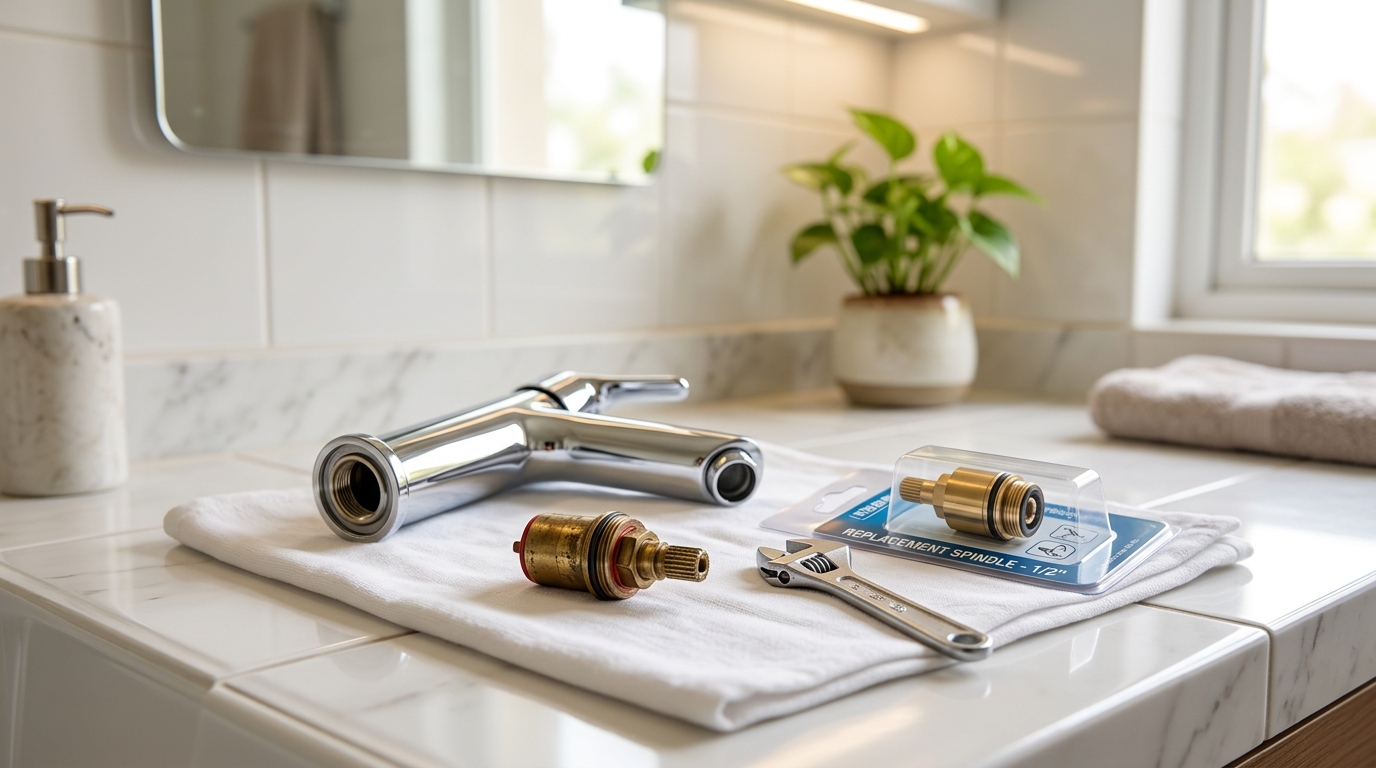
How to Change a Tap Spindle in 2026: Step-by-Step Guide
Your bathroom tap in Bopal, Ahmedabad — or anywhere across India — starts dripping the moment you tighten it. You call a plumber, he charges ₹300 just to show up, looks at the tap for two minutes, and tells you the spindle is worn out. That’s a situation every Indian homeowner has faced at least once. Knowing how to change spindle in tap yourself can save you both money and the wait. The spindle is the internal threaded rod that controls water flow, and replacing it is one of the most straightforward plumbing repairs you can do at home. Before you call anyone, browse compatible tap spindles for your brand — you may be able to fix this in under 30 minutes.
2026 Tap Spindle Price Guide (INR)
Tap spindle prices in India vary significantly based on material quality, brand compatibility, and whether you’re buying a standalone spindle or a complete repair kit. In 2026, raw material cost increases have pushed spindle prices up by roughly 10–15% compared to 2023 levels. Understanding the price tiers helps you avoid overpaying — or buying a substandard part that fails within months.
The table below covers three market tiers commonly available across Indian online and offline hardware stores. Installation costs are estimated based on standard plumber rates in metros and tier-2 cities.
| Tier | Brand Examples | Spindle Part Cost (₹) | Plumber Labour (₹) | Total Estimated Cost (₹) |
|---|---|---|---|---|
| Generic / Unbranded | Local market, unbranded brass or plastic spindles | ₹30 – ₹80 | ₹150 – ₹300 | ₹180 – ₹380 |
| Standard / Mid-Range | Essco, ARK, LnK, LMC, Goldline, Cavier, Aquel | ₹80 – ₹220 | ₹200 – ₹350 | ₹280 – ₹570 |
| Premium / OEM Compatible | Jaquar, Cera, Parryware, Hindware, ESS ESS, Marc, Johnson, Kohler, Grohe | ₹220 – ₹650 | ₹300 – ₹500 | ₹520 – ₹1150 |
Pro Tip: Always buy a brand-compatible spindle rather than a generic one — even if it costs ₹100 more. Generic spindles in hard water areas like Rajasthan, Gujarat, and parts of Maharashtra often fail within 6–8 months due to mineral buildup on the threads.
- DIY replacement eliminates the ₹200–₹500 labour cost entirely
- A complete spindle kit (spindle + washer + O-ring) costs ₹120–₹400 for standard brands
- Buying online from JKC Emart often saves 15–25% compared to local hardware store pricing
- Free shipping above ₹499 makes multi-part orders especially economical
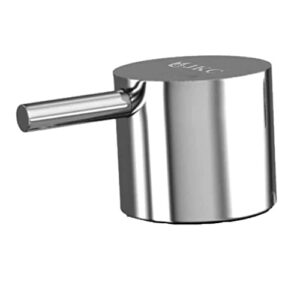
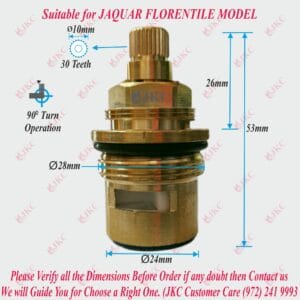
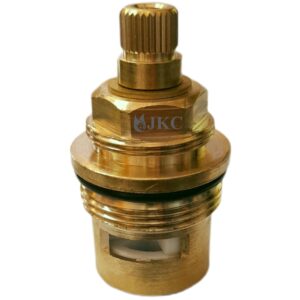
Shop These Parts on JKC Emart:
Signs You Need to Replace Your Tap Spindle
A worn tap spindle rarely fails overnight — it gives you clear warning signs over days or weeks. Catching these early can prevent water wastage and avoid damage to the tap body itself. In older housing colonies across cities like Pune’s Sadashiv Peth or Delhi’s Lajpat Nagar, taps are often 8–15 years old and spindle wear is extremely common.
Ignoring a failing spindle leads to progressively worse leaks, and eventually the tap seat itself gets damaged — turning a ₹150 repair into a ₹2,000 replacement job. Here are the most reliable signs that your spindle needs changing:
- Dripping from the spout even after fully closing the tap — the most common symptom of a worn spindle washer or damaged spindle tip
- Leaking from the tap body or gland — water seeping around the handle area indicates a deteriorated O-ring or spindle packing
- Stiff or hard-to-turn handle — corroded or limescale-encrusted spindle threads cause this, especially in hard water zones
- Handle spins freely without stopping water — the spindle thread is stripped and needs immediate replacement
- Visible rust or green corrosion on the spindle when you open the tap for other repairs
- Water pressure drop from one specific tap in the house while others work normally
Plumber’s Insight: If your tap drips at a rate of one drop per second, it wastes approximately 10,000 litres of water per year. In cities with water scarcity like Chennai or Bengaluru, fixing a leaking spindle is not just a maintenance task — it’s a necessity.
Brand Compatibility Guide for Tap Spindles
One of the most common mistakes Indian homeowners make is buying a spindle that doesn’t fit their tap brand. Indian sanitaryware brands use different thread sizes, spindle lengths, and seat configurations — a Jaquar spindle will not directly fit a Parryware tap body without modification. Knowing your brand’s spindle type before ordering is critical.
JKC Emart stocks genuine compatible spindles for all major Indian and international brands. You can view all brand-compatible tap spindles on JKC Emart to find the exact match for your tap. The table below outlines common brand-spindle compatibility categories:
| Brand | Spindle Type | Thread Size (Approx.) | Compatibility Notes |
|---|---|---|---|
| Jaquar | Brass spindle with flat seat washer | 1/2″ BSP | Jaquar-specific thread pitch; use OEM-compatible parts only |
| Cera | Brass or chrome-plated spindle | 1/2″ BSP | Compatible with many standard Indian spindle kits |
| Parryware | Brass spindle, longer shaft | 1/2″ BSP | Shaft length varies by tap series; verify model |
| Hindware | Standard brass spindle | 1/2″ BSP | Widely compatible with mid-range spindle kits |
| ESS ESS / Marc | Brass spindle with rubber washer | 1/2″ BSP | Standard thread; ARK/LnK compatible spindles often fit |
| Kohler / Grohe / Roca | Ceramic disc or precision brass spindle | Metric / proprietary | Use only brand-specific or certified compatible parts |
| Johnson / Jal / Aris / Aquel | Standard brass spindle | 1/2″ BSP | Broadly compatible across Indian standard spindle range |
- Always check if your tap uses a ceramic disc cartridge or a traditional rubber washer spindle — they are not interchangeable
- For imported brands like Grohe, Duravit, or American Standard, always confirm the part number before ordering
- If your tap is over 10 years old, take a photo of the old spindle before ordering a replacement
Browse Compatible Parts:
Step-by-Step: How to Change a Spindle in a Tap
Changing a tap spindle is a repair any careful homeowner can complete without professional help. The entire process typically takes 20–40 minutes for a standard Indian pillar tap or wall-mounted tap. Follow each phase carefully and you’ll have a leak-free tap by the end.
Tools You Will Need
- Adjustable spanner or wrench (200mm recommended)
- Flathead screwdriver (medium size)
- Phillips screwdriver (for handle screw)
- Nose pliers (for removing O-rings)
- PTFE tape (plumber’s thread seal tape)
- Replacement spindle kit (spindle + washer + O-ring for your brand)
- Dry cloth or towel
- Small bucket or tray (to catch residual water)
Phase 1: Shut Off Water and Disassemble the Tap
Before touching any tap component, shut off the water supply at the isolation valve under the basin or at the main stopcock. Open the tap fully to drain any residual water in the pipe — this prevents water spraying when you open the tap body. Place your small bucket or tray under the tap to catch drips.
Remove the tap handle by locating the decorative cap on top (usually a small plastic disc marked H or C). Pry it off gently with a flathead screwdriver and unscrew the handle screw beneath it. Pull the handle straight upward to remove it from the spindle stem.
- If the handle is stuck, wiggle it gently side to side — never force it or you risk cracking the tap body
- On older taps, the handle may be secured with a grub screw on the side — check before pulling
- Keep all small screws and caps in a small bowl so nothing rolls away
Phase 2: Remove the Old Spindle
With the handle off, you’ll see the gland nut — the large hexagonal nut that holds the spindle assembly in place. Use your adjustable spanner to turn this nut counter-clockwise (anti-clockwise) to loosen and remove it. Once the gland nut is off, the entire spindle assembly can be pulled or unscrewed out of the tap body.
Examine the removed spindle carefully. The rubber washer at the bottom tip is usually the first component to fail — it gets compressed and flattened over years of use. The O-ring around the spindle body is the second most common failure point, causing leaks around the handle area.
- Note the orientation and position of the O-ring before removing it — photograph it if needed
- If the spindle thread is visibly stripped or corroded, the entire spindle must be replaced — not just the washer
- Compare the old spindle against your new replacement part before proceeding
Pro Tip: While the tap is open, inspect the tap seat (the brass ring inside the tap body where the washer presses). If it looks pitted or grooved, use a tap reseating tool before fitting the new spindle — otherwise the new washer will leak from day one.
Phase 3: Fit the New Spindle and Reassemble
Fit the new rubber washer onto the spindle tip and secure it with the small brass screw. Slide the new O-ring into its groove on the spindle body — apply a tiny amount of silicone grease or petroleum jelly to help it seat smoothly without tearing. Insert the new spindle assembly into the tap body and hand-tighten it clockwise.
Wrap 2–3 layers of PTFE tape clockwise around the gland nut threads before screwing it back in. This ensures a watertight seal and makes future removal easier. Tighten the gland nut with your spanner — firm but not over-tight, as over-tightening can crack older tap bodies.
- Reattach the tap handle and secure the handle screw — do not over-tighten
- Press the decorative cap back into place
- Ensure the spindle is in the fully open position before turning the water supply back on
Phase 4: Test and Check for Leaks
Slowly open the water supply valve. Let the water run for 30 seconds and then close the tap fully. Watch the spout for any dripping — a correctly fitted spindle should stop water flow completely within 1–2 seconds of closing. Check the gland nut area for any seeping water.
If there’s still a slight drip, try tightening the gland nut by a quarter turn. If leaking persists around the handle, the O-ring may not be seated correctly — open the tap again and recheck. A successful spindle replacement should give you 3–7 years of leak-free operation depending on water quality.
- Run the tap at full pressure for 2 minutes to check for any pressure-related leaks
- Wipe the tap body dry and check again after 10 minutes to catch slow seeping leaks
- If the tap body itself is cracked, no spindle replacement will fix the leak — the tap needs full replacement
Common Mistakes Homeowners Make When Replacing a Tap Spindle
Even a straightforward repair like a spindle replacement can go wrong if you skip key steps. These are the four most common errors Indian homeowners make — and how to avoid them.
Mistake 1: Buying the Wrong Spindle Size or Brand
Many homeowners buy a generic spindle from the local hardware store without checking brand compatibility. A spindle that’s 2mm shorter or has a slightly different thread pitch will either not seat correctly or will fail within weeks. Always match the spindle to your tap brand and model — take the old spindle to the store or order online with the brand name clearly specified.
- Measure spindle length from tip to top of thread before ordering
- Check thread type: BSP (British Standard Pipe) vs metric threads are not interchangeable
- For Jaquar, Cera, and Parryware taps, always use brand-compatible spindles from verified suppliers like JKC Emart
Mistake 2: Not Replacing the O-Ring Along with the Spindle
Replacing only the bottom washer and reinstalling the old spindle is a partial fix at best. The O-ring on the spindle body deteriorates at roughly the same rate as the washer — if you don’t replace it, you’ll have a leak-free spout but water seeping around the handle within weeks. Always buy a complete spindle kit that includes the O-ring.
Mistake 3: Over-Tightening the Gland Nut
Tightening the gland nut too hard is one of the most common causes of tap body cracks, especially in older brass taps. The correct technique is to tighten until firm resistance is felt, then add no more than a quarter turn. Over-tightening also compresses the O-ring excessively, causing it to fail faster.
Plumber’s Insight: If you’re working on a tap that’s more than 12 years old, consider replacing the entire tap rather than just the spindle. At that age, the tap seat, body, and chrome finish are all likely compromised — a new tap costs ₹400–₹1,500 and gives you a fresh 10-year service life.
Mistake 4: Skipping PTFE Tape on the Gland Nut Threads
Reassembling without PTFE tape on the gland nut threads is a shortcut that causes slow seeping leaks that are hard to detect until they’ve already damaged the wall or cabinet below. PTFE tape costs less than ₹20 per roll and takes 30 seconds to apply — there’s no reason to skip it.
- Wrap PTFE tape in the direction of the thread (clockwise as viewed from the end)
- 2–3 layers is sufficient — more than 5 layers can make the nut difficult to tighten correctly
- PTFE tape is available at any hardware store and on JKC Emart’s Amazon store listing
How to Identify the Right Tap Spindle for Your Tap
Ordering the correct spindle without a plumber’s help is entirely possible if you know what to look for. Indian taps use a relatively standardised set of spindle configurations, but there are enough variations between brands to cause problems if you guess. Here’s a systematic approach to identifying the right part.
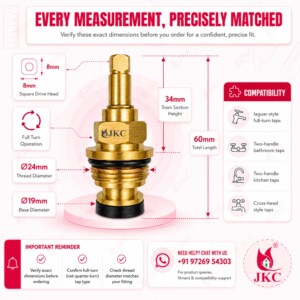
The three key measurements you need are: spindle length, thread diameter, and spindle tip type (flat washer seat vs ceramic disc). These three dimensions will narrow your choice to 2–3 compatible spindles in any supplier’s catalogue.
- Spindle length: Measure from the bottom of the thread to the top of the stem (excluding the handle attachment point). Common lengths are 45mm, 55mm, 65mm, and 75mm for Indian pillar taps.
- Thread diameter: Most Indian taps use 1/2″ BSP (approximately 20.9mm outer diameter). Some wall-mounted mixer taps use 3/4″ BSP.
- Spindle tip type: Traditional taps use a brass spindle with a rubber washer at the tip. Modern ceramic disc taps use a cartridge-style spindle — these are not interchangeable.
- Brand and model number: Check the tap body for any stamped or embossed model code — Jaquar, Cera, and Parryware all stamp model numbers on the tap body near the base.
Pro Tip: If you can’t find the model number, take a clear photo of the removed spindle next to a ruler and share it with JKC Emart’s customer support at cu**********@******rt.in or call +91 97269 54303. Their team can identify the correct replacement part for you.
- For Jaquar taps: look for the Jaquar logo on the tap body and the 4-digit model code stamped near the base
- For Cera and Parryware: model codes are usually on the tap body near the water inlet connection
- For unbranded or older taps: measure the spindle physically and match by dimensions
Hard Water and Indian Climate Considerations for Tap Spindles
India’s water supply varies dramatically in hardness across regions. Cities like Jaipur, Ahmedabad, Surat, Nagpur, and parts of Delhi have notoriously hard water with high calcium and magnesium content. This mineral-rich water accelerates spindle wear in two specific ways: limescale deposits on the spindle threads and corrosion of the rubber washer.
Limescale buildup on spindle threads is one of the leading causes of stiff taps and stripped threads in hard water zones. Over 12–18 months, mineral deposits can effectively bond the spindle to the tap body, making removal extremely difficult without damaging the tap. The solution is both preventive and reactive.
- Preventive: Apply a thin coat of silicone grease to spindle threads during installation — this creates a barrier against mineral adhesion
- Preventive: Install an inline water softener or sediment filter at the inlet to reduce mineral load
- Reactive: If the spindle is stuck due to limescale, apply white vinegar around the gland nut area and wait 30 minutes before attempting removal
- Material choice: In hard water areas, choose full brass spindles over chrome-plated or zinc alloy spindles — brass resists corrosion significantly better
Monsoon humidity also affects tap spindles — particularly in coastal cities like Mumbai, Kochi, Visakhapatnam, and Chennai. High ambient humidity accelerates corrosion of exposed metal components, especially in bathrooms without adequate ventilation. Stainless steel or brass spindles with corrosion-resistant coatings are strongly recommended for these regions.
Pro Tip: In hard water areas, plan to inspect and replace tap spindle washers every 18–24 months as routine maintenance — even if the tap isn’t visibly leaking. This prevents the progressive seat damage that turns a ₹150 washer replacement into a ₹1,500 tap replacement.
- Coastal zone recommendation: brass or stainless steel spindles with EPDM rubber washers
- Hard water zone recommendation: full brass spindles with silicone O-rings (more chemical-resistant than standard rubber)
- Standard city supply zones: standard brass spindle kits from brands like Essco, ARK, or brand-compatible Jaquar/Cera spindles
How to Buy the Right Tap Spindle Online
Ordering a tap spindle online without a plumber’s guidance is straightforward if you follow a systematic approach. The Indian online hardware market has matured significantly — in 2026, verified sellers like JKC Emart offer genuine brand-compatible parts with clear specifications, making it easier than ever to get the right part delivered to your door.
Here are six practical steps to confidently order the correct spindle without guesswork:
- Identify your tap brand first. Check the tap body for the brand name or logo — Jaquar, Cera, Parryware, Hindware, or others. This is your starting filter for any online search.
- Remove the old spindle before ordering. Physically remove the spindle (follow Phase 1 and 2 above) and measure its length and thread diameter. This eliminates guesswork entirely.
- Search by brand + part type. Search terms like “Jaquar tap spindle” or “Cera 1/2 inch spindle kit” on JKC Emart or Amazon India will return accurate results. Avoid generic searches like “tap spindle” alone — the results are too broad.
- Check the product description for compatibility notes. Reputable sellers like JKC Emart list compatible tap models and brands in the product description. If compatibility information is absent, contact the seller before ordering.
- Buy a complete kit, not just the spindle. Always buy a spindle kit that includes the O-ring and rubber washer. Buying these separately costs more and risks mismatched sizing.
- Verify return policy before checkout. JKC Emart offers a 7-day easy return policy — this gives you the confidence to order even if you’re not 100% certain about the fit. If the part doesn’t fit, you can return it without hassle.
You can order the correct tap spindle directly on JKC Emart with free shipping on orders above ₹499. JKC Emart’s expert customer support team is also available at +91 97269 54303 to help you identify the right part if you’re unsure.
- Orders above ₹499 qualify for pan-India free shipping
- JKC Emart is also available on Amazon India for Prime delivery options
- All parts are 100% genuine quality — not cheap duplicates that fail within months
- Contact cu**********@******rt.in with your tap photo for expert part identification
Ready to Order? Here Are the Top Picks:
Frequently Asked Questions
Q1: How do I know if my tap spindle needs replacing or just the washer?
If the tap drips from the spout but closes smoothly, the problem is usually just the rubber washer at the spindle tip — you may not need a full spindle replacement. However, if the handle is stiff, the tap leaks around the gland area, or the handle spins without stopping water flow, the spindle itself is damaged and needs full replacement. In most cases, since spindle kits cost only ₹80–₹250, it’s more economical to replace the entire assembly rather than just the washer. This also ensures you don’t have to open the tap again in 6 months for the O-ring.
Q2: Can I change a tap spindle without turning off the main water supply?
No — you must turn off the water supply before opening any tap for spindle replacement. If you don’t have an isolation valve under the basin, you’ll need to shut off the main stopcock for the flat or house. Attempting to remove a spindle with water pressure active will result in water spraying under pressure, which can cause injury and water damage. In Indian apartments, the isolation valve is usually located under the washbasin cabinet or behind the wall near the tap connection point.
Q3: How long does a tap spindle last in India?
A good quality brass spindle from brands like Jaquar, Cera, Parryware, or Essco typically lasts 5–10 years under normal use conditions. In hard water areas (Rajasthan, Gujarat, parts of Haryana), lifespan can drop to 3–5 years due to mineral deposits on threads. The rubber washer at the spindle tip usually needs replacement every 2–4 years even if the spindle itself is fine. Coastal cities with high humidity may see faster corrosion on lower-quality spindles — invest in full brass or stainless steel spindles for these locations.
Q4: What is the difference between a tap spindle and a tap cartridge?
A traditional tap spindle is a brass threaded rod with a rubber washer at the tip — it works by screwing the washer down onto the tap seat to stop water flow. A tap cartridge is a self-contained ceramic disc unit used in modern single-lever and quarter-turn taps — it controls both flow and temperature in one sealed unit. These two are completely different components and are not interchangeable. Most older Indian pillar taps use spindles; newer designer taps from Kohler, Grohe, and premium Jaquar series use cartridges. Always identify which type your tap uses before ordering a replacement.
Q5: Is it cheaper to replace the tap spindle or buy a new tap entirely?
For taps less than 8 years old, replacing the spindle is almost always more economical — the part costs ₹80–₹650 depending on brand, versus ₹400–₹3,000 or more for a new tap plus installation. For taps older than 10–12 years, the economics shift — the tap seat may be damaged, the chrome finish is likely worn, and other components may fail soon after. In these cases, investing in a new tap makes more long-term sense. A good rule of thumb: if the repair cost exceeds 40% of the replacement tap cost, consider replacing the full unit.
Conclusion
Changing a tap spindle is one of those home repairs that looks intimidating until you do it once — and then you wonder why you ever paid a plumber ₹400 for a 15-minute job. With the right spindle kit, a basic adjustable spanner, and the step-by-step process outlined in this guide, most Indian homeowners can complete this repair confidently. The key is buying the correct brand-compatible spindle before you start, not after you’ve already disassembled the tap.
JKC Emart stocks genuine, brand-compatible tap spindles for all major Indian sanitaryware brands — Jaquar, Cera, Parryware, Hindware, ESS ESS, Marc, Essco, ARK, and more. Every part is 100% genuine quality, not the cheap duplicates that fail within months. With pan-India free shipping on orders above ₹499, a 7-day easy return policy, and availability on Amazon India for Prime delivery, getting the right spindle delivered to your door in Mumbai, Delhi, Bangalore, Chennai, or any city across India has never been easier. For part identification help, reach the JKC Emart team at cu**********@******rt.in or call +91 97269 54303.
Browse All Spare Parts at JKC Emart and fix that dripping tap today.


About author







Add comment
You must be logged in to post a comment.