
How to Open a Tap Spindle: Step-by-Step Guide 2026
How to Open a Tap Spindle: Step-by-Step Guide 2026
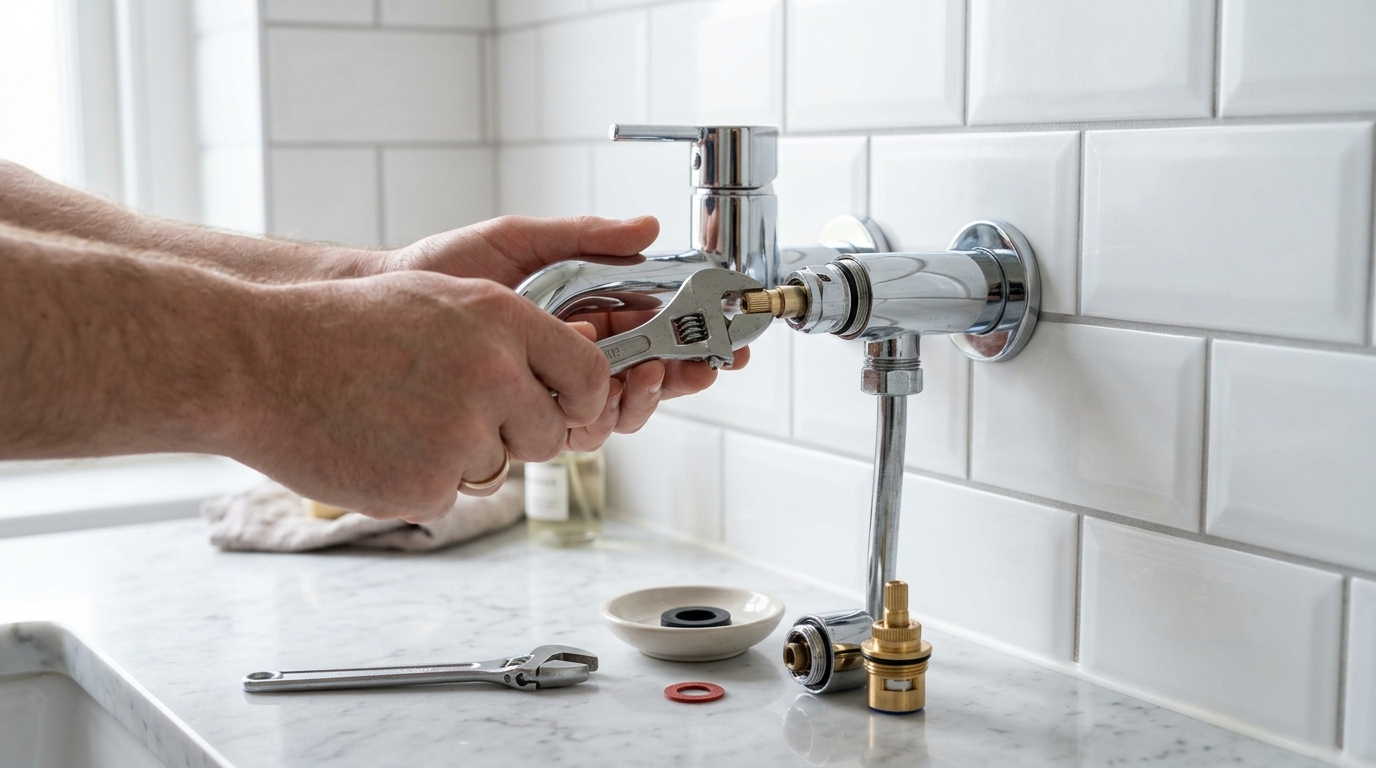
If your bathroom tap in Borivali, Rajajinagar, or any older apartment colony is dripping non-stop even after you shut it tight, the culprit is almost always a worn-out tap spindle. Knowing how to open a tap spindle correctly — without cracking the tap body or stripping the threads — can save you a plumber call and get your tap working like new in under 30 minutes. Before you reach for a wrench, though, it helps to understand what you are dealing with: a tap spindle is the internal screw mechanism that controls water flow, and it wears out faster than most homeowners expect. You can shop compatible tap spindles for all major Indian brands before you even start the job, so the replacement is ready the moment the old one comes out.
2026 Tap Spindle Price Guide (INR)
Tap spindle prices in India have seen a 10–15% increase since 2022 due to rising brass and rubber raw material costs. The good news is that even premium-brand spindles remain far cheaper than replacing an entire tap assembly. Here is a realistic 2026 price breakdown across quality tiers for the Indian market.
| Tier | Brand Examples | Spindle Price (INR) | Plumber Installation Cost (INR) | Total Estimated Cost (INR) |
|---|---|---|---|---|
| Generic / Local | Unbranded, local market parts | ₹30 – ₹80 | ₹150 – ₹300 | ₹180 – ₹380 |
| Standard | Essco, ARK, LnK, LMC, Goldline, Cavier | ₹80 – ₹200 | ₹150 – ₹300 | ₹230 – ₹500 |
| Premium | Jaquar, Cera, Parryware, Hindware, ESS ESS, Marc, Aquel, Aris | ₹200 – ₹600 | ₹200 – ₹400 | ₹400 – ₹1,000 |
| International / Luxury | Kohler, Grohe, Geberit, Roca, American Standard, Duravit | ₹500 – ₹1,500+ | ₹300 – ₹600 | ₹800 – ₹2,100+ |
If you choose to do the replacement yourself — which this guide fully equips you to do — you eliminate the plumber cost entirely. A DIY tap spindle replacement costs only the part price, which is typically ₹80 to ₹600 for most Indian homes. Always buy from a verified supplier to avoid counterfeit spindles that fail within weeks.
Pro Tip: Always buy one extra spindle for the other tap in the same bathroom. If one spindle has worn out, the second one is usually not far behind — and you save on shipping costs by ordering both together.
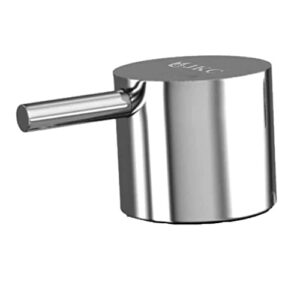
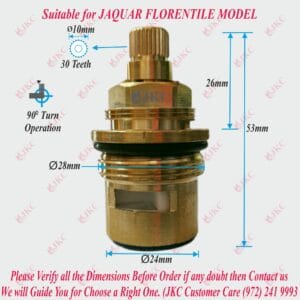
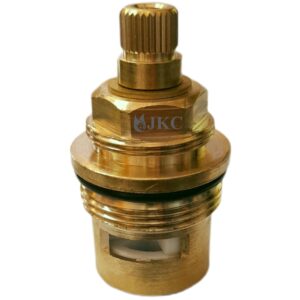
Shop These Parts on JKC Emart:
Signs You Need to Open and Replace Your Tap Spindle
Before you start dismantling your tap, confirm that the spindle is actually the problem. Many homeowners in cities like Pune and Lucknow waste money on full tap replacements when only the spindle washer or O-ring needs attention. Here are the clear warning signs that it is time to open your tap spindle.
Constant Dripping Even When Tap Is Closed
This is the most common symptom of a worn tap spindle washer. When the rubber washer at the base of the spindle degrades, it can no longer create a watertight seal against the tap seat. You will notice a slow but persistent drip from the tap spout even when the handle is fully closed and tightened.
- Dripping that gets worse over time — not better
- Water dripping even when handle is over-tightened
- Visible mineral staining on the spout from constant moisture
Stiff or Hard-to-Turn Tap Handle
If turning your tap handle requires significant force, the spindle threads are likely corroded, or the O-ring has swollen due to hard water mineral deposits. This is especially common in cities with high TDS water like Ahmedabad, Surat, and Jaipur. Forcing a stiff handle without addressing the spindle can crack the tap body.
Reduced or Uneven Water Flow
A damaged or partially blocked spindle can restrict water flow even when the tap is fully open. You may notice the water stream is thinner than usual, or it spurts unevenly. This often happens when limescale builds up around the spindle threads or when the spindle body itself is cracked.
- Water pressure noticeably lower than other taps in the same house
- Gurgling or sputtering sounds when tap is opened
- Handle turns fully but water flow remains restricted
- Visible rust or greenish corrosion around the tap bonnet
You can browse Jaquar, Cera, and Parryware compatible tap spindles on JKC Emart to find the exact replacement before you open the tap. Having the part ready saves you from leaving a disassembled tap overnight waiting for delivery.
Browse Compatible Parts:
How to Identify the Right Tap Spindle Before Opening
Opening a tap spindle without having the correct replacement part ready is one of the biggest mistakes homeowners make. Tap spindles are not universal — they vary by brand, tap body size, thread pitch, and spindle length. Here is how to identify exactly what you need.
Thread Type and Size
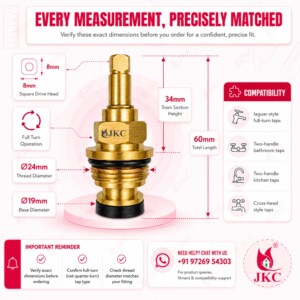
Indian tap spindles typically come in 1/2 inch (15mm) and 3/4 inch (20mm) sizes, corresponding to the tap body inlet size. The thread pitch also varies — some brands use a finer thread, others a coarser one. When you remove the old spindle, measure the total length and count the thread turns per centimetre before ordering.
- 1/2 inch spindles: Most common in bathroom basin taps and kitchen sink taps
- 3/4 inch spindles: Used in larger pillar taps and garden/utility taps
- Spindle length: Typically 45mm to 75mm — measure carefully
- Washer seat diameter: Usually 14mm or 16mm — check before ordering
Brand Compatibility
Each major Indian sanitaryware brand uses slightly different spindle geometries. A Jaquar tap spindle will not fit a Cera tap body, and a Parryware spindle is not interchangeable with an ESS ESS tap. Always identify your tap brand from the handle cap or the tap body stamp before purchasing.
Here is a quick compatibility reference for the most common brands available in the Indian market in 2026:
| Brand | Common Spindle Type | Typical Size | Notes |
|---|---|---|---|
| Jaquar | Brass body, rubber washer | 1/2 inch | Premium thread; avoid generic replacements |
| Cera | Brass/ceramic disc | 1/2 inch | Some models use ceramic cartridge instead |
| Parryware | Brass body, rubber washer | 1/2 inch | Widely available; good standard thread |
| Hindware | Brass body, rubber washer | 1/2 inch | Compatible with several ARK alternatives |
| ESS ESS / Marc | Brass body, rubber washer | 1/2 inch | Verify model number before ordering |
| Kohler / Grohe | Ceramic cartridge | Varies | Always use brand-specific or OEM-compatible parts |
Plumber’s Insight: When in doubt, take the old spindle to a hardware store or photograph it against a ruler and share it with JKC Emart’s customer support at +91 97269 54303. Their team can help you identify the exact compatible part within minutes.
Step-by-Step Guide: How to Open a Tap Spindle
This is the core of what you came here for. Follow these phases carefully and you will have your tap spindle out — and a new one fitted — without calling a plumber. This process applies to most standard pillar taps, bib taps, and wall-mounted taps found in Indian homes.
Tools You Will Need
- Adjustable spanner or open-end wrench (12–14mm or 17–19mm depending on tap)
- Flat-head screwdriver (for removing handle cap and screw)
- Phillips screwdriver (some handles use Phillips screws)
- Pliers (for gripping if the bonnet nut is corroded)
- PTFE tape (Teflon tape) for resealing threads
- Replacement tap spindle (ordered in advance from JKC Emart)
- Small container or bucket to catch residual water
- Penetrating oil (WD-40) for corroded nuts
Phase 1: Shut Off Water Supply
This is non-negotiable. Locate the stop cock or isolation valve under the wash basin, behind the wall panel, or at the main water inlet for that bathroom. Turn it clockwise until it stops. Open the tap fully to drain any residual water from the pipe — this prevents a sudden gush when you remove the spindle.
- Turn the stop cock fully clockwise (right) to shut off supply
- Open the tap to release residual pressure and drain water
- Place a small towel or bucket under the tap to catch drips
- Confirm no water is flowing before proceeding
Phase 2: Remove the Tap Handle
Most Indian tap handles have a decorative cap on top — usually marked with H (Hot) or C (Cold), or the brand logo. Pry this cap off gently with a flat-head screwdriver. Underneath you will find either a Phillips head screw or a hex bolt holding the handle to the spindle stem.
- Pry off the decorative cap using a flat-head screwdriver — be gentle to avoid scratching
- Unscrew the handle screw (clockwise to loosen — remember: lefty loosey)
- Pull the handle straight upward — it should slide off the spindle stem
- If the handle is stuck, wiggle it gently side to side; never force it upward with a lever
Pro Tip: If the handle refuses to come off after removing the screw, the spindle stem may have corroded to the handle insert. Apply a small amount of WD-40 around the stem base, wait 5 minutes, then try again. Never hammer the handle from below — you will crack the tap body.
Phase 3: Unscrew and Remove the Spindle
With the handle removed, you will see the bonnet nut — a hexagonal brass nut that holds the spindle assembly inside the tap body. This is the most critical step in learning how to open a tap spindle correctly. Use your adjustable spanner to grip the bonnet nut firmly.
- Place the spanner on the bonnet nut — turn counter-clockwise (anti-clockwise) to loosen
- If the nut is corroded and stuck, apply WD-40 and wait 10 minutes before trying again
- Once loose, continue unscrewing by hand — the spindle will begin to back out of the tap body
- Fully unscrew and pull the entire spindle assembly straight out
- Keep the bonnet nut, packing nut, and any washers together — you may reuse them
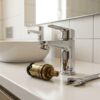
Inspect the removed spindle carefully. Look for a worn rubber washer at the base, corroded brass threads, or a cracked spindle body. In most cases, the rubber washer alone needs replacement — but if the brass body is corroded or the threads are damaged, replace the entire spindle.
Phase 4: Inspect and Replace
Lay the old spindle on a flat surface and compare it side by side with your new replacement spindle from JKC Emart. They should match in total length, thread pitch, washer seat diameter, and stem profile. If they match, proceed. If there is any discrepancy, contact JKC Emart support before installing.
- Check that the new spindle’s thread matches the tap body thread
- Confirm the rubber washer is included and correctly seated at the spindle base
- Inspect the tap seat inside the tap body — if it is pitted or scored, use a tap reseating tool before fitting the new spindle
- Wrap 2–3 layers of PTFE tape around the spindle threads for a better seal
Phase 5: Reassemble and Test
Insert the new spindle into the tap body by hand, threading it clockwise until it seats. Then use your spanner to tighten the bonnet nut — firm but not over-tightened. Over-tightening is one of the most common causes of cracked tap bodies in Indian bathrooms.
- Thread the new spindle in clockwise by hand until snug
- Tighten the bonnet nut with a spanner — approximately 1/4 turn past hand-tight
- Refit the tap handle and tighten the handle screw
- Replace the decorative cap
- Slowly open the stop cock and check for leaks around the bonnet nut
- Test the tap — open and close it several times to confirm smooth operation
Pro Tip: After reassembly, leave the tap slightly open for 30 seconds to flush out any debris that may have entered the tap body during the replacement process. This prevents debris from damaging the new spindle washer immediately.
Common Mistakes Homeowners Make When Opening a Tap Spindle
Most DIY tap spindle failures are not caused by the part itself — they are caused by avoidable errors during the opening and replacement process. Here are the four most common mistakes seen in Indian homes, particularly in older housing societies in Mumbai, Delhi, and Hyderabad.
- Mistake 1: Not shutting off the water supply first. Sounds obvious, but many homeowners try to “quickly” loosen the bonnet nut before shutting the water off. The moment the nut releases, water floods out under pressure. Always shut the stop cock completely before touching the bonnet nut.
- Mistake 2: Using the wrong size spanner. An ill-fitting spanner slips and rounds off the corners of the bonnet nut, making it nearly impossible to remove without a pipe wrench. Always use the correct open-end spanner size — typically 17mm or 19mm for most Indian taps.
- Mistake 3: Over-tightening the new spindle. Many homeowners assume that tighter means better sealing. In reality, over-tightening compresses the rubber washer excessively, causes it to deform, and can crack the tap body — especially in older chrome-plated brass taps. Tighten to firm, not forceful.
- Mistake 4: Buying a generic spindle that does not match the brand. A ₹30 local market spindle may look similar to a genuine Jaquar or Cera spindle, but the thread pitch, washer seat diameter, and brass quality are often different. These fail within weeks and can damage the tap seat. Always buy brand-compatible genuine parts from a verified supplier like JKC Emart.
Plumber’s Insight: In 2026, with genuine spare parts available online with next-day delivery across most Indian cities, there is no reason to compromise on part quality. The cost difference between a generic and a genuine spindle is usually less than ₹150 — but the genuine part lasts 5–10 times longer.
Hard Water and Indian Climate Considerations for Tap Spindles
India’s water quality varies dramatically by region, and this directly impacts how long your tap spindle lasts and how difficult it is to open when the time comes. Cities like Jaipur, Ahmedabad, Surat, Nagpur, and parts of Delhi have notoriously hard water with high TDS (Total Dissolved Solids) levels above 500 ppm. This accelerates limescale buildup inside the tap body and around the spindle threads.
Limescale deposits essentially cement the spindle in place over time. When you try to open the bonnet nut, you may find it refuses to budge despite applying significant force. This is not a defective part — it is the result of years of mineral accumulation.
- Apply penetrating oil (WD-40 or equivalent) generously around the bonnet nut and let it soak for 15–30 minutes before attempting to open
- Use a rubber mallet to gently tap the spanner handle — this vibration helps break the mineral bond without stressing the tap body
- After replacement, apply a thin coat of plumber’s grease to the spindle threads — this prevents future mineral bonding
- In hard water areas, inspect and service tap spindles every 18–24 months rather than waiting for a failure
The Indian summer heat also plays a role — thermal expansion and contraction of brass components over years of 40°C+ summers causes micro-stress in the spindle body. In coastal cities like Mumbai, Chennai, and Kochi, salt-laden humidity accelerates brass corrosion on exposed spindle components. Choosing a chrome-plated or nickel-plated spindle over bare brass provides significantly better corrosion resistance in these climates.
Pro Tip: If you are in a hard water area, consider installing an inline water softener or filter at the inlet — it extends the life of all your plumbing fittings, not just tap spindles, by 2–3 times.
How to Buy the Right Tap Spindle Online
With the rise of online plumbing hardware shopping across India in 2026, buying a tap spindle without a plumber’s help is entirely practical — if you know what to look for. Here are six practical tips to help you order the correct part confidently from your phone or laptop.
- Identify your tap brand first. Check the tap handle cap, the tap body, or any documentation from when the tap was installed. Brand names like Jaquar, Cera, Parryware, Hindware, ESS ESS, or Marc are usually stamped or embossed on the tap body near the base.
- Photograph the old spindle before removing it. Take clear photos of the spindle from the side (showing full length), from the bottom (showing the washer and seat), and of the thread section. Share these photos with the seller to confirm compatibility.
- Measure the spindle length and thread size. Use a ruler to measure the total spindle length in millimetres. Note whether it is a 1/2 inch or 3/4 inch spindle. This information alone narrows down your options significantly.
- Check the product description for brand compatibility. Reputable sellers like JKC Emart list exactly which brands and tap models each spindle is compatible with. Never buy a spindle that just says “universal fit” without specific brand compatibility listed.
- Order from verified suppliers with return policies. Look for sellers offering at least a 7-day return window in case the part does not fit. JKC Emart offers a 7-day easy return policy and genuine quality assurance across all spindle products.
- Check for pan-India shipping. If you are in a tier-2 city like Vadodara, Coimbatore, or Bhopal, confirm the seller ships to your pin code. JKC Emart offers free shipping on orders above ₹499 across India, and their products are also available on Amazon India for Prime delivery.
You can order the correct tap spindle directly on JKC Emart with full brand compatibility details, clear product images, and expert support available at cu**********@******rt.in or +91 97269 54303.
Ready to Order? Here Are the Top Picks:
Frequently Asked Questions
Q1: How do I know if my tap spindle needs to be replaced or just the washer?
When you open the tap spindle, inspect the rubber washer at the base first. If the washer is cracked, flattened, or missing chunks, replacing just the washer (which costs ₹5–₹20) may solve the dripping problem. However, if the brass spindle body shows corrosion, stripped threads, or cracks, the entire spindle must be replaced. As a general rule, if the spindle is more than 5–7 years old in a hard water area, replace the whole unit — a new washer on a corroded spindle body will not hold for long. JKC Emart stocks both individual washers and complete spindle assemblies for all major brands.
Q2: Can I open a tap spindle without shutting off the main water supply?
Technically, if your tap has an individual isolation valve (stop cock) directly under the basin or behind an access panel, you only need to shut that valve — not the main supply. However, if no isolation valve is present, you must shut the main water inlet for that bathroom or for the entire home. Never attempt to loosen the bonnet nut with water pressure active — the moment the spindle unseats, water will spray with full line pressure, potentially causing water damage and injury. Installing isolation valves under each fixture is a worthwhile upgrade that makes future maintenance much easier.
Q3: My tap bonnet nut is completely stuck and won’t turn — what should I do?
A stuck bonnet nut is almost always caused by limescale or corrosion bonding the nut to the tap body. Apply WD-40 or a dedicated penetrating oil generously around the nut base and let it soak for at least 20–30 minutes. Then use a correctly sized open-end spanner — not an adjustable wrench, which can slip and round the nut corners. If it still won’t move, try gently tapping the spanner handle with a rubber mallet to break the mineral bond through vibration. As a last resort, a plumber with a pipe wrench and heat gun (to expand the metal slightly) can usually free even the most stubborn bonnet nuts without damaging the tap body.
Q4: How long does a tap spindle typically last in an Indian home?
In normal water conditions (TDS below 300 ppm), a good quality brass tap spindle from brands like Jaquar, Cera, or Parryware will last 8–12 years before the rubber washer needs replacement and 15+ years before the spindle body itself fails. In hard water areas with TDS above 500 ppm — common in Rajasthan, Gujarat, and parts of Maharashtra — this lifespan drops to 4–6 years for the rubber components. Generic or unbranded spindles in hard water areas may fail in as little as 1–2 years. The rubber washer is always the first component to fail, followed by the O-ring, and finally the brass body itself.
Q5: Is it safe to use PTFE tape when reassembling a tap spindle?
Yes — PTFE tape (Teflon tape) is highly recommended when reassembling a tap spindle. Wrap 2–3 layers clockwise around the spindle threads before inserting it into the tap body. PTFE tape fills microscopic gaps in the threads, prevents water seepage around the bonnet nut, and also makes future removal significantly easier by preventing the threads from seizing due to corrosion. Use plumber’s-grade PTFE tape (white, 12mm width) — the type available at any hardware store across India for ₹20–₹50 per roll. Do not use too many layers, as this can make the spindle difficult to thread in and may prevent proper seating of the washer against the tap seat.
Conclusion: Fix Your Dripping Tap Today with the Right Spindle
Opening a tap spindle is one of the most practical plumbing skills an Indian homeowner can have in 2026. With the right tools, the correct replacement part, and the step-by-step process outlined in this guide, you can fix a dripping tap in under 30 minutes — without paying a plumber’s call-out fee. The key is always to identify your tap brand, buy a genuine compatible spindle, and follow the phases in order: shut off water, remove handle, open bonnet nut, replace spindle, reassemble, and test.
JKC Emart stocks genuine, brand-compatible tap spindles for all major Indian brands including Jaquar, Cera, Parryware, Hindware, ESS ESS, Marc, Essco, ARK, Aquel, Aris, Johnson, Jal, LnK, LMC, Goldline, Cavier, Kohler, Grohe, and more. With free pan-India shipping on orders above ₹499, a 7-day easy return policy, and expert customer support at +91 97269 54303 or cu**********@******rt.in, getting the right part has never been easier. You can also find JKC Emart’s products on Amazon India for fast Prime delivery. Do not let a dripping tap waste thousands of litres of water and hundreds of rupees in water bills — fix it today.
About author





Add comment
You must be logged in to post a comment.